Cellular Jet Lag Recovery: The Science of Energy Restoration and Travel Medicine to Manage Fatigue (The Ultimate Masterclass Edition)


Prologue: The Invisible Toll of Global Mobility
Hello everyone. I am Dr. Chirat Sukme (Dr. Poom), Medical License No. 59894, a physician experienced in travel medicine and preventive healthcare at Go & Grow Clinic Pattaya.
In today's globalized era, seamless connectivity means that international executives, business leaders, and global nomads frequently travel across continents and time zones. While a flight from London to Bangkok or across the Pacific to Southeast Asia may take only a few hours, our biology cannot adapt to the speed of air travel instantly.
This phenomenon can trigger a condition commonly known as jet lag, which occurs when the body's internal circadian rhythm becomes misaligned with the local time. Jet lag can manifest not only as mistimed sleepiness but also as fatigue, difficulty concentrating, cognitive impairment ("brain fog"), and digestive disturbances.
As a physician caring for both local and international patients in Pattaya, I have observed many individuals struggling with fatigue and disrupted sleep after long-distance travel. I have written this Masterclass article to explore the science of biological clocks and present travel medicine strategies incorporating the vitamin therapy program in Pattaya and the IV drip program in Pattaya as components of an individualized approach to post-travel recovery.
Chapter 1: Chronobiology & the Molecular Clock – Molecular Basis of Biological Time

To truly understand jet lag management, we must first understand chronobiology—the biology of human time.
Our bodies do not operate randomly; they are governed by a complex network of biological clocks divided into two main systems:
1. The Master Clock
Located in a small cluster of neurons in the hypothalamus known as the suprachiasmatic nucleus (SCN), the master clock receives light signals through the retina and helps regulate the rhythm of several physiological processes, including the production of two important hormones:
Melatonin: A hormone associated with sleep that generally rises as darkness falls and helps regulate sleep timing and core body temperature.
Cortisol: A hormone involved in alertness and metabolism that normally follows a daily rhythm, with levels generally peaking in the morning.
2. Peripheral Clocks
Remarkably, many organs—including the liver, kidneys, heart, muscles, and skin—possess their own peripheral clocks, which are regulated in part through the expression of clock genes such as CLOCK, BMAL1, and PER.
What Happens When We Cross Time Zones?
When you fly across multiple time zones, the master clock in the brain (SCN) may gradually adjust to the destination's light–dark cycle. However, peripheral clocks in organs such as the liver and muscles may adjust at different rates. This can result in internal desynchronization, in which different physiological systems are temporarily out of sync. This misalignment may contribute to fatigue, digestive disturbances, difficulty sleeping, and reduced cognitive performance.
Chapter 2: Cellular Fatigue & Mitochondrial Function – The Cellular Energy Connection

When the biological clock is disrupted, changes may occur in multiple physiological systems, including those involved in cellular energy metabolism.
1. ATP Production
Mitochondria convert nutrients and oxygen into ATP (adenosine triphosphate), the primary energy currency used by cells. Circadian disruption and sleep loss can alter metabolic regulation, contributing to fatigue and reduced physical and cognitive performance.
2. Oxidative Stress
Travel-related factors, including sleep disruption, psychological stress, and environmental conditions, can contribute to oxidative stress and the generation of reactive oxygen species (ROS). Excessive oxidative stress can affect cellular structures and may contribute to inflammatory processes.
3. NAD+
NAD+ (nicotinamide adenine dinucleotide) is an essential coenzyme involved in cellular energy metabolism and numerous biological processes. NAD+ levels and metabolism are influenced by age, cellular activity, and physiological conditions. Ongoing research is exploring its relationship with mitochondrial function, DNA repair, and cellular aging.
This is why caffeine should not be considered a complete solution for jet lag. It can temporarily increase alertness, but it does not correct the underlying circadian misalignment.
Chapter 3: Bioavailability & the Science of IV Therapy – Why Intravenous Delivery?

Many patients ask, "When I am tired from traveling, can I just take oral multivitamins or drink electrolyte water?"
The pharmacokinetic answer involves bioavailability:
Feature | Oral Ingestion | Intravenous (IV) Drip Program |
Absorption Route | Absorbed through the gastrointestinal tract and subject to first-pass metabolism. | Delivered directly into the bloodstream. |
Plasma Concentration | Influenced by gastrointestinal absorption and metabolism. | Can achieve predictable circulating concentrations. |
Onset of Availability | Depends on digestion and absorption. | Immediately available in the bloodstream. |
Higher intravenous bioavailability does not necessarily translate into superior clinical outcomes in all individuals. The route of administration should be selected according to clinical indication and individual assessment. When appropriate, an IV drip program in Pattaya can provide fluids and selected nutrients directly into the bloodstream. However, IV therapy should be considered based on an individual's medical needs and is not a replacement for adequate hydration, nutrition, sleep, or the treatment of an underlying medical condition.
Chapter 4: Precision Recovery Protocols at Go & Grow Clinic – Individualized Recovery Programs

At Go & Grow Clinic Pattaya, formulas are selected according to travel medicine principles and individualized patient needs, with the goal of supporting recovery and overall health and wellness.
1. NAD+ Wellness Support Program
Physiological Mechanism: NAD+ is a coenzyme involved in cellular energy metabolism and several biological pathways associated with cellular maintenance.
Proposed Role / Clinical Considerations: NAD+ is an essential coenzyme involved in cellular energy metabolism and various biological processes. However, clinical evidence regarding the efficacy of intravenous NAD+ for fatigue, sleep, or jet lag remains limited. Therefore, it should be considered as individualized adjunctive care and should not replace standard management guidelines for jet lag.
2. Myers' Cocktail & Executive Boost Program
Components: B-Complex Vitamins (function as essential coenzymes in energy metabolism), Magnesium (involved in muscle and nervous-system function), and Ascorbic Acid (contributes to normal immune function and antioxidant protection).
3. Hydration & Nutritional Support Program
Components: Long-haul flights and travel-related changes in routine may contribute to dehydration. This program is designed to support fluid and electrolyte balance, incorporating selected nutrients and antioxidants to support overall recovery.

Chapter 5: Integrated Travel Medicine Protocols – Integrated Circadian Realignment

According to standard travel medicine guidelines (such as those from the CDC), I recommend integrating a multimodal recovery strategy to help realign the body's biological clock before considering adjunctive care:
1.Targeted Light Exposure/Avoidance:
Natural sunlight is the most powerful external cue (zeitgeber). Appropriately timed light exposure and avoidance is a key method for realigning the biological clock, with the optimal timing depending on the direction of travel, the number of time zones crossed, and the individual's circadian phase. For example, when traveling eastward (e.g., Europe to Thailand), appropriately timed morning light exposure may help the body adjust. Conversely, reducing exposure to bright light from screens before local bedtime supports sleep.
2.Sleep Scheduling:
Gradually shift your sleep schedule to align with the destination time zone before or immediately upon arrival.
3.Strategic Hydration & Meal Timing:
Maintain adequate hydration by drinking water regularly and avoiding excess alcohol or caffeine. Align meal times with the new local time zone.
4.Destination-Time Activities:
Engage in gentle physical activities (e.g., a light walk along the Pattaya coast) during daytime hours to encourage movement and alignment with local routines.
5.Appropriately Timed Melatonin:
Exogenous melatonin may be considered and used at appropriate times to facilitate sleep onset and circadian alignment, strictly under medical guidance. For circadian phase shifting, high-dose melatonin is generally not required; the CDC Yellow Book notes that doses of approximately 0.5–1 mg are often sufficient for shifting the biological rhythm. The timing of administration is more critical than increasing the dose.
Adjunctive Supportive Care:
Following individualized medical assessment, IV fluid or nutrient therapy may be considered as adjunctive supportive care when clinically appropriate; however, it is not an established treatment for circadian realignment.
Chapter 6: Clinical Case Study – From Accumulated Fatigue to Regional Meetings
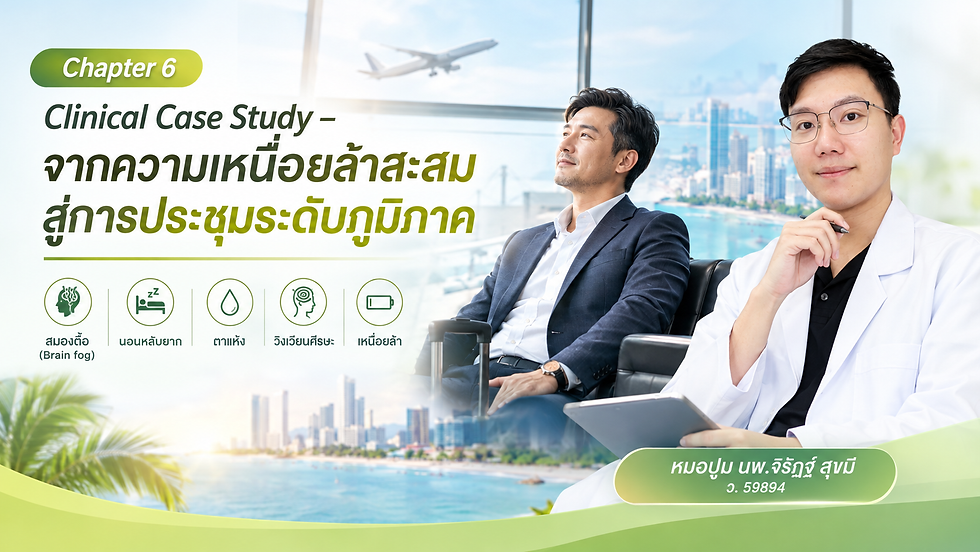
(Note: The following case study is a clinical illustration based on an individual patient experience. Results may vary by individual.)
Patient Background: David (pseudonym), 45, a senior executive, took an overnight flight from Frankfurt to Thailand and traveled directly to Pattaya to prepare for an EEC economic-zone meeting.
Initial Symptoms: The patient consulted me with dizziness, brain fog, slowed cognitive responses, and severe fatigue. He had difficulty sleeping because his internal body clock remained misaligned.
Treatment Approach by Dr. Poom:
Assessment: Blood pressure and heart rate were checked, and hydration status was evaluated.
Behavioral Guidance: The patient was advised on appropriately timed light exposure and sleep scheduling according to travel medicine guidelines.
Adjunctive Supportive Care: The NAD+ Wellness Support Program and a vitamin therapy program formulated with selected nutrients and magnesium were administered according to the patient's assessment.
Patient-Reported Outcomes:
Following behavioral guidance on sleep, timed light exposure, rest, and individualized adjunctive care, David reported approximately seven hours of sleep and felt more refreshed the following morning. However, it cannot be determined whether these changes were the direct result of any single specific component of the care provided. His dizziness had noticeably improved, allowing him to deliver his presentation and participate in business discussions.
Chapter 7: In-Depth Travel Medicine Q&A with Dr. Poom (Dr. Chirat Sukme, Medical License No. 59894)

Q1: When is the best time to receive an IV drip program in Pattaya for jet lag recovery?
Dr. Poom: The appropriate timing depends on the individual's health status, hydration level, symptoms, and treatment goals. An IV drip should not be considered a treatment that directly resets the circadian clock. When clinically appropriate, it may be used to support hydration and nutritional needs following travel.
Q2: How does the NAD+ program differ from standard vitamin drips?
Dr. Poom: Standard vitamin drips (such as those containing vitamin C or B-complex) provide nutrients involved in normal metabolic processes. NAD+ is a coenzyme involved in cellular energy metabolism and other biological pathways. They have different compositions and proposed mechanisms, and treatment should be selected according to the individual's clinical assessment and goals.
Q3: Is intravenous nutrient delivery safe, and what precautions should be taken?
Dr. Poom: Safety is paramount. Prior to every service, a physician reviews the patient's medical history, current medications, allergies, renal and cardiac status, as well as specific contraindications or precautions for the planned substances—such as screening for G6PD deficiency before considering high-dose intravenous vitamin C. All fluids and nutrients are prepared and administered under medical supervision throughout the session.
Q4: Can individuals who do not cross time zones but do shift work receive this treatment?
Dr. Poom: Individuals who work shifts or experience sleep disruption may require an individualized medical assessment. Vitamin therapy may be considered as supportive care when clinically appropriate, but it does not replace the evaluation of the underlying causes of insomnia or circadian disruption.
Epilogue: Reclaim Your Vitality for Every Destination

Global travel offers opportunities to expand our personal and business horizons. Jet lag and travel-related fatigue do not have to be overlooked. Understanding circadian biology and using appropriate travel-health strategies can help support adjustment to a new time zone.
If you are planning a trip to Pattaya or have just stepped off a long-haul flight and require targeted support for travel-related fatigue, my team and I at Go & Grow Clinic are ready to provide a consultation and develop a personalized healthcare plan.
Attending Physician: Dr. Chirat Sukme (Dr. Poom), Medical License No. 59894 Founder of Go & Grow Clinic Pattaya "Passion with Purpose for All"
(Note: Treatment results and recovery times may vary depending on individual physiological factors and health conditions. Please consult a physician for an assessment before receiving treatment.)
For Inquiries and Appointments (Go & Grow Clinic Pattaya)
📞 Tel: 064-269-9522
💬 LINE Official: Click to add friend and consult with Dr. Poom
📘 Facebook Fanpage: Go and Grow Clinic
📸 Instagram: @go_growclinic
📍 Location: Pattaya City, Chonburi Province | Click to open Google Maps for directions to the clinic


Comments