The Wrinkle Eraser: Wrinkle and Jawline Care with the Nabo and Aller Botox Programs — A Muscle-Balancing Technique


Introduction: Addressing Wrinkles and Jawline Contour Through Balanced Muscle Relaxation
Hello, I'm Dr. Chirat Sukme (Dr. Poom), a physician at Go & Grow Clinic in Pattaya.
One thing I hear often from patients in consultation is a version of: "I'd like to address the wrinkles that make my face look tired, and refine my jawline a bit — but I'm worried about ending up with a frozen look, losing the ability to raise my eyebrows, or having a smile that doesn't look natural."
This concern is entirely reasonable. The face is our primary tool for communicating emotion, expressing who we are, and forming first impressions. Allowing age-related wrinkles to affect one's appearance, or having treatment go wrong in a way that removes natural expression, isn't the outcome anyone is looking for.
In this article, I'll walk through the biology behind facial wrinkles and how facial muscles work, and introduce the Nabo and Aller Botulinum Toxin programs, along with the tension-free technique I use in practice — an approach focused on balancing muscle tension rather than eliminating movement altogether.
Chapter 1: Facial Muscle Anatomy and How Wrinkles Form

Understanding wrinkles and facial contour concerns starts with looking beyond the surface layer of skin, at the underlying architecture — a biological system involving collagen networks, muscles, and bone structure that work together continuously.
Dynamic vs. Static Wrinkles
Dynamic wrinkles: These form from the contraction of facial expression muscles beneath the skin — for example, when smiling, frowning, or raising the eyebrows. In younger skin, which typically has more collagen and elastin, the skin tends to spring back smoothly once the muscle relaxes.
Static wrinkles: Over time, and as collagen naturally declines with age, the skin at these fold lines can lose some structural support. As a result, the lines may remain visible even when the face is at rest.
When dynamic wrinkles form repeatedly over time without any intervention, they can gradually become more static in nature, which is generally more complex to address and may benefit from a combination of approaches.
Key Facial Muscles That Shape Expression and Contour
Frontalis muscle (forehead): Raises the eyebrows and forehead; frequent use is associated with horizontal forehead lines.
Corrugator supercilii & procerus (glabellar muscles): Draw the eyebrows together and downward, associated with frown lines ("11 lines") between the brows.
Orbicularis oculi (muscle around the eyes): Contracts during smiling and squinting, associated with crow's feet at the outer corners of the eyes.
Masseter muscle (jaw muscle): The largest and strongest chewing muscle; overuse — such as from chewing tough foods or teeth grinding (bruxism) — can lead to muscle hypertrophy, which may contribute to a wider, more square lower facial contour.
Platysma muscle (neck muscle): A thin sheet of muscle that can act as a depressor, pulling the lower face downward over time.
Chapter 2: How the Nabo and Aller Botulinum Toxin Programs Work
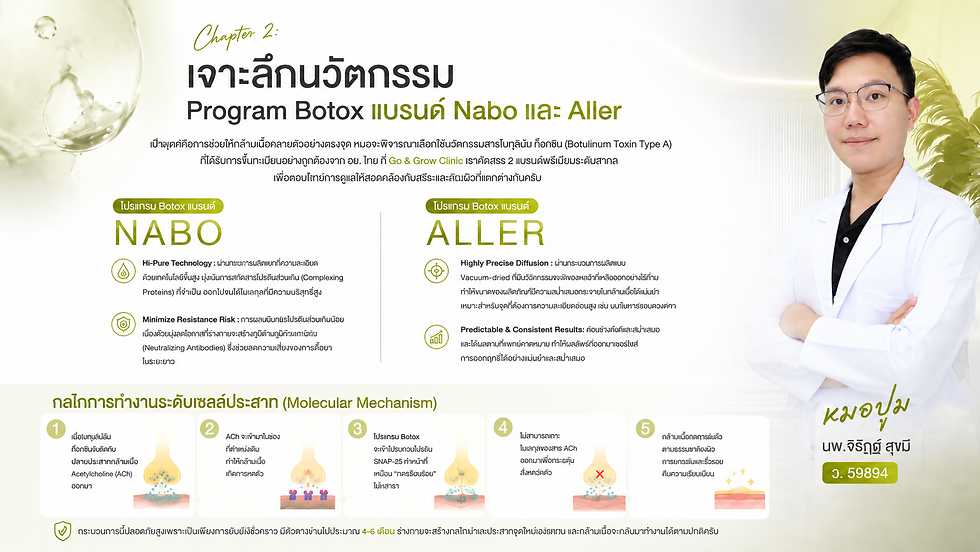
For targeted muscle relaxation, I use Botulinum Toxin Type A products that are properly registered with the Thai FDA. At Go & Grow Clinic, we work with two internationally recognized brands, selected to suit different muscle characteristics and treatment goals.
The Nabo Program (High-Purity Formulation from South Korea)
Hi-Pure Technology: This product undergoes an advanced purification process aimed at reducing complexing proteins that aren't required for the toxin's activity, resulting in a high-purity formulation.
Reduced resistance risk: Reducing these additional proteins is thought to help lower the likelihood of the immune system developing neutralizing antibodies, which is one of the factors associated with reduced responsiveness over repeated treatments when appropriate treatment intervals are followed.
The Aller Program (Original Formulation from the United States)
Precise diffusion: Produced using a vacuum-dried process, this formulation is associated with a relatively narrow, controllable diffusion radius, allowing more targeted placement without affecting neighboring muscles as much — useful for delicate areas such as around the eyes or eyebrow region.
Consistent, well-studied results: With an extensive clinical research history, this formulation allows for fairly predictable dosing and outcomes.
How It Works at the Cellular Level
Normally, when the brain signals a muscle to contract, nerve endings release a chemical messenger called acetylcholine (ACh), which binds to receptors on the muscle. Botulinum Toxin works by interfering with a protein called SNAP-25 at the nerve ending, which is involved in the release of ACh. With ACh release reduced, the muscle relaxes. As the previously overactive muscle relaxes, the overlying skin — which had been repeatedly folded — gets a period of rest, and the associated wrinkles may become less noticeable. This effect is temporary and considered generally safe, as the nerve ending naturally regenerates its signaling function over roughly 4–6 months, at which point the muscle gradually returns to its usual activity.
Chapter 3: The Tension-Free Technique — A Personalized, Muscle-Balancing Approach

Treatment at Go & Grow Clinic isn't based on applying injections to fixed textbook points. Dr. Chirat Sukme approaches each case as an individualized assessment, since muscle thickness, strength, and pulling direction vary from person to person.
Dynamic Facial Assessment
Before treatment, patients are typically asked to make a range of expressions — raising the eyebrows, frowning, smiling widely, and clenching the jaw — to observe how each muscle group is functioning. This helps identify which muscles are overactive and which should be left more untouched, to help preserve natural expression.
The Tension-Free Concept
Micro-droplet precision: Rather than concentrating a large volume at a single point, treatment typically involves distributing smaller amounts across multiple points, at an appropriate depth for the specific muscle, aiming for a gentler overall effect.
Agonist-antagonist balance: The face has muscle groups that work in opposing directions — elevators and depressors. Treatment aims to balance the tension between these groups; for example, when addressing frown lines, care is taken not to over-relax the muscles that help support eyebrow position, to avoid an unintended brow-drooping effect.
A preventive, expression-preserving approach: The goal isn't to eliminate all muscle movement, but to ease the specific tension contributing to wrinkle formation, while preserving enough muscle activity for natural smiling and expression — helping to reduce the likelihood of a "frozen" appearance.
Chapter 4: Personalized Lower-Face Contouring

Beyond wrinkle treatment, addressing jaw width and lower-face contour is a more advanced consideration that should take into account underlying bone structure and gender-specific aesthetic goals.
Masseter Muscle Assessment
Assessment typically begins with palpation, to help distinguish whether a wider lower face is primarily related to bone structure, fat, the parotid gland, or the masseter muscle. Where the masseter muscle is a significant contributing factor, reducing its activity through Botulinum Toxin treatment can, over time, lead to a gradual reduction in muscle bulk, which may result in a more tapered, defined jawline appearance over approximately 4–8 weeks.
The "Nefertiti Lift" Technique
For patients concerned about jawline definition or mild skin laxity in that area, treatment of the platysma muscle (a neck muscle that can act as a downward-pulling force) may also be considered. Reducing this downward pull can allow the muscles responsible for lifting the face to function somewhat more effectively, which may contribute to a more defined jawline appearance.
Gender-Specific Aesthetic Considerations
For female patients: Treatment is typically planned to support a softer, more oval or V-shaped contour, with careful attention to dosing to avoid excessive muscle reduction that could lead to hollowed cheeks or unwanted skin laxity.
For male patients: Over-narrowing the jaw can sometimes reduce a patient's masculine facial characteristics. Treatment is typically planned to reduce excess muscle bulk while preserving a reasonably broad, somewhat angular jaw structure, to maintain a defined jawline.

(Note: The case description and mechanism of action above are provided as general medical information. Individual results vary depending on muscle structure and personal response to treatment.)
Chapter 5: Safety Standards, Cold Chain, and Aftercare

Good aesthetic outcomes should always be built on a foundation of safety, from product quality through to aftercare.
Cold Chain Management
Botulinum Toxin is a protein that is highly sensitive to temperature. Improper storage or transport can degrade the protein structure, reducing its effectiveness. At Go & Grow Clinic, cold chain management is maintained carefully to help preserve product integrity.
Verifying Genuine, Registered Products
Thai FDA registration: Both the Nabo and Aller products should have Thai-language product information and a clear Thai FDA registration number.
Matching lot numbers: The lot number and expiry date on the outer box should match the label on the vial inside.
QR code verification: Genuine products typically include a hologram or QR code sticker that can be scanned to verify authenticity through the importer's system.
Aftercare Guidance
First 4 hours: It's generally advisable to avoid lying flat or face-down, to reduce pressure on the treated area and limit unintended spread to nearby muscles.
First 2 weeks: Avoiding significant heat exposure — such as saunas, hot tubs, hot yoga, or heat-based facial laser treatments — is generally recommended, as heat may affect how the product settles in the early period.
Gentle skincare: Washing your face, applying skincare, and wearing makeup as usual is generally fine. It's advisable to handle the treated area gently and avoid vigorous massage or pressure for about a week.
Chapter 6: Frequently Asked Questions

Q1: What is "Botox resistance," and how does the clinic try to help reduce this risk?
Dr. Chirat Sukme: Resistance can occur when the body develops antibodies against the toxin, which may reduce its effect over repeated treatments. My general approach is to use high-purity products and, importantly, to maintain appropriate treatment intervals — typically recommending at least 4–6 months between sessions, and avoiding frequent small "touch-up" doses more often than necessary, which may help reduce the likelihood of triggering an immune response.
Q2: Can Botox treatment be combined with dermal fillers or lifting devices?
Dr. Poom: These can often be combined, and may complement each other — for example, relaxing muscles that pull the face downward alongside a lifting treatment, or addressing wrinkles around the eyes alongside filler in the same area. That said, the appropriate sequence and timing should be assessed individually based on the patient's skin structure and treatment goals.
Q3: How soon will I notice a difference, and how long do results typically last?
Dr. Poom: For expression-related wrinkles (forehead, glabella, crow's feet), patients typically start to notice smoother skin within about 3–7 days. For the masseter muscle, the gradual reduction in size tends to become noticeable over roughly 3–8 weeks. On average, results last approximately 4–6 months, though this can vary based on muscle strength, individual response, and lifestyle factors.
Q4: If I stop treatment, will my wrinkles or jaw appearance become worse than before?
Dr. Poom: This is a common concern, but generally not accurate. As the treatment effect naturally wears off, the muscle gradually resumes its usual activity, and wrinkles or jaw size tend to return to roughly their pre-treatment state — rather than becoming worse or progressing more rapidly than they otherwise would have. In fact, consistent treatment over an appropriate period may help reduce the likelihood of dynamic wrinkles progressing into more permanent static lines, compared with no treatment at all.
Contact Information & Appointments
Choosing to address wrinkles and jawline contour isn't just about selecting a product — it's about choosing a clinic that prioritizes safety, with a physician who has a thorough understanding of facial anatomy, to help achieve results that support your natural confidence.
If you're considering treatment for wrinkles, or would like an assessment of your facial contour, I'm happy to provide an honest, personalized consultation.
Physician: Dr. Chirat Sukme (Dr. Poom) — Thai Medical License No. 59894
🌐 Book a Consultation with Dr. Chirat Sukme (Dr. Poom)
📞 Phone: 064-269-9522
💬 LINE Official: Click to add and consult Dr. Poom
📘 Facebook Fanpage: Go and Grow Clinic
📸 Instagram: @go_growclinic
📍 Location: Pattaya, Chonburi | Click to open Google Maps directions to the clinic


Comments